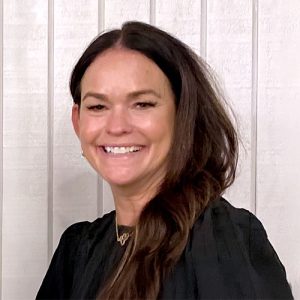
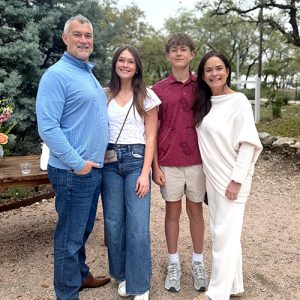
 A registered nurse and a devoted mother of two, Kim built her life around caring for others, volunteering, and managing her family’s busy schedule. Then her life changed in an instant: she had a stroke and Kim was forced to pause her life in ways she never expected. But she made up her mind to do everything she could to regain her independence and get her life back.
On the morning of September 9, 2025, shortly after returning home from visiting her daughter at college, Kim collapsed. She immediately noticed left-sided facial droop, weakness in her left arm, and slurred speech. At first, she struggled to accept what was happening. “I was in denial,” she said. “But as soon as I saw myself in the mirror, I knew I was having a stroke.” Fortunately, her husband was home that morning and quickly rushed Kim to the hospital.
Kim was admitted to St. David’s South Austin Medical Center and was later transferred to Texas Neuro Rehabilitation for inpatient care. Despite being active and having no traditional stroke risk factors, doctors discovered a pulmonary embolism in her lung, a deep vein thrombosis in her leg, and a previously undiagnosed patent foramen ovale (PFO), a small opening in the heart that allowed a clot to travel to her brain.
After two weeks in the hospital and two more weeks of inpatient rehabilitation, Kim returned home and began Day Treatment at Centre for Neuro Skills’ (CNS) Austin clinic on September 30.
“From a visual perspective, nobody would know,” Kim said. “I was walking and talking, but my left arm was completely flaccid.”
 Kim required assistance while walking at first, but she was determined to get better. She asked her physical therapist what it would take to walk on her own. “I told her I’d do whatever she asked me to do, plus twenty more,” she said. “I refused to be down. This couldn’t be my life.”
Through persistence and hard work, she regained the ability to walk independently. Occupational therapy focused on rebuilding strength in her left arm and shoulder that caused neck and shoulder pain. Kim worked closely with her therapist, and she still continues to perform the exercises she learned. Speech and cognitive therapy addressed facial weakness, while counseling provided emotional support throughout the daily challenges of recovery. “She listened to me cry every day,” Kim said. Her recovery was supported by a strong network of friends, family, and neighbors who also took turns driving her to the CNS clinic. Regaining her independence became a major milestone. After completing and passing a driving course at St. David’s Rehabilitation Hospital, Kim was driving again.
Kim was discharged from CNS in early December. Today, she continues to focus on her health while easing back into her daily routine with her family. Recently, she discovered an adaptive tool that allows her to style her hair independently, marking a meaningful step toward regaining independence in daily activities she once relied on friends to help with.
Surrounded by a community that never stopped showing up for her, Kim keeps moving forward.
“I’m going to keep on trucking,” she said. “I’m not stopping until I feel full again.”


CNS Monthly Newsletter
The latest CNS updates, including events, company information, and patient care developments
The Inside View
Quarterly magazine focused on brain injury research, rehabilitation, and advancements shaping the field
Sign-up for one or both to stay connected with brain injury news and recover